
Combined effects of marine heatwaves and nano-titanium dioxide
(nano-TiO:) on the physiological fitness in the mussel Mytilus coruscus
1.Introduction:
Modern industrial technology,s progress has boosted nanomaterial usage in various industries due to their varied sizes and unique physi- cochemical properties (Kumar et al., 2024). For example, nano-Titanium Dioxide (nano-TiO:) is widely used in many different industries, such as cosmetics, coatings, plastics, food packaging, and environmental puri- fication, because of its high refractive index, outstanding UV-blocking capabilities, and photocatalytic activity (Chen and Mao, 2007). How- ever, the production of nano-TiO: in industries always results in waste, leading to the environmental discharge and accumulation of ecotoxic substances, which raises critical scientific concerns about the potential effects of these pollutants on ecosystems and human health (Dube and Okuthe, 2023). The global nano-TiO2market reached approximately US $22 billion in 2024 and is projected to maintain a compound annual growth rate (CAGR) of over 5.5 % from 2025 to 2034 (Global Market Insights, 2025). Meanwhile, recent environmental monitoring has
detected nano-TiO2 concentrations of 20–50 μg/L in surface waters and 100–900 μg/L in the water column (Labille et al., 2020). It is well- documented that nano-TiO: can enter aquatic organisms through ingestion or filtration and produce oxidative stress, membrane damage, immune dysfunction, and altered gene expression, posing serious risks to the reproduction, growth, and survival of various aquatic animals, including mussels Mytilus coruscus (0.1 mg/L) (Sun et al., 2024), Mytilus trossulus (0.2–1 mg/L) (Kukla et al., 2018), fish Cyprinodon variegatus (nano-TiO2) (0.1–10 mg/L) (Milton et al., 2025), Carassius auratus (0.2–2 mg/L) (Gulsoy and Bilgiseven, 2025), and crab Charybdis japonica (0.1 mg/L) (Amouri et al., 2025). These physiological responses may pose significant risks to the growth, reproduction, and survival of bi- valves. In light of the projected increase in nano-TiO: concentrations in aquatic environments, it is essential to investigate its release and accu- mulation in marine ecosystems under both environmentally relevant exposure levels and extreme environmental concentration.
The physiological condition of marine organisms is shaped by the
- Corresponding author.
E-mail address: youjiwang2@gmail.com (Y. Wang).
1 These authors contributed equally to this work
https://doi.org/10.1016/j.marpolbul.2025.118659
Received 14 July 2025; Received in revised form 25 August 2025; Accepted 29 August 2025 Available online 11 September 2025
0025-326X/© 2025 Elsevier Ltd. All rights are reserved, including those for text and data mining, AI training, and similar technologies.
combined influence of multiple oceanic environmental factors, such as salinity fluctuations, dissolved oxygen concentrations, ocean acidifica- tion, and temperature (Franke et al., 2024; Ivanina et al., 2020; Khan et al., 2020; Velasco et al., 2019). Among these environmental variables, temperature plays a pivotal role in modulating metabolic activity, enzymatic functions, and the overall energy balance of marine organ- isms (Martinez et al., 2016; Sokolova, 2023). As water temperature in- creases, the basal metabolic rate of aquatic animals rises significantly, leading to greater demands for oxygen and nutrients (Schulte, 2015). Temperature fluctuations can also impair immune system function, diminishing immune responsiveness under suboptimal thermal condi- tions and thereby increasing susceptibility to disease (Stillman et al., 2025). Furthermore, temperature fluctuations can disrupt nutrient ab- sorption and utilization. In particular, elevated temperatures have been shown to alter the phosphorus-to-nitrogen demand ratio in certain bi- valves and crustaceans, thereby impairing their growth and develop- mental processes (Laspoumaderes et al., 2022). Simultaneously, elevated temperatures often shorten the developmental cycles of ecto- thermic organisms, thereby reducing reproductive success and poten- tially leading to developmental abnormalities in reproductive systems or reduced viability under chronic exposure (Peck et al., 2004). These temperature-induced physiological alterations not only influence indi- vidual fitness but also play a critical role in shaping species, ecological adaptability and overall population stability (Ohlberger, 2013).
The interaction between temperature and nano-TiO: plays a pivotal role in influencing its surface characteristics, physical structure, and associated biological and environmental impacts. Elevated temperatures can induce phase transitions in nano-TiO:, resulting in increased crys- tallinity and enhanced photocatalytic performance. Elevated tempera- tures can induce phase transitions in nano-TiO:, resulting in increased crystallinity and enhanced photocatalytic performance, which leads to the production of excessive ROS in organisms and thereby induces oxidative stress (Kim et al., 2021; Ma et al., 2012). Higher temperatures may facilitate nanoparticle agglomeration, consequently reducing their effective surface area and enhancing adsorption capacity, thereby altering their uptake and accumulation in organisms (Amouri et al., 2024; Tan et al., 2017). In aquatic toxicology, temperature serves as a critical modulator of organismal physiology, thereby influencing the sensitivity and response of aquatic species to nanoparticle exposure. In bivalves, for instance, elevated temperatures accelerate metabolic pro- cesses, which may lead to increased uptake of nano-TiO: and intensified physiological stress (Masanja et al., 2023). Experimental evidence has shown that the combined effects of elevated temperature and nano-TiO: can amplify immune responses, increase oxidative stress, and exacerbate tissue damage in marine organisms (Boukadida et al., 2017).
Filter-feeding sessile marine bivalves play a vital role in marine ecosystems by improving water quality through filtration, providing habitat structure, and serving as a food source for higher trophic levels (Qian et al., 2024).These organisms are highly sensitive to environ- mental fluctuations, and their physiological alterations often serve as early warning signals of ecosystem stress. Due to their open circulatory system, bivalves remain in direct contact with the external environment, making hemocytes among the first responders to environmental changes. Subsequent effects include tissue damage and disruptions in cellular function. To cope with such stressors, bivalves activate adaptive mechanisms such as upregulating stress-related genes and enhancing energy production.
Consequently, in this study, we examined the physiological changes of Mytilus coruscus under the combined stress effects of nano-TiO: (0 μg/ L, 25 μg/L, and 250 μg/L) and the MHWs system comprising two tem- peratures (22 ◦ C and 28 ◦ C). This was achieved through an integrated analysis of hemocyte dynamics, immune-oxidative status, mitochondrial activity, stress-related gene expression, and shell structural integrity. Although extensive research has investigated the impacts of climate change and emerging pollutants on marine organisms, the combined effects of multiple environmentally prevalent and interacting stressors
in marine ecosystems remain poorly understood. Therefore, we comprehensively evaluated the combined toxicological effects of MHWs and nano-TiO: on the mussel Mytilus coruscus. We hypothesized that exposure to MHWs and nano-TiO: would lead to impaired physiological conditions in Mytilus coruscus, and this damage would be exacerbated under their combined influence. This study will provide valuable in- sights into the adaptive capacity of marine bivalves to environmental stress and offer guidance for their conservation in the context of climate change.
2.Materials and methods:
2.1. Animals collection and nano-TiO2 preparation
Mytilus coruscus specimens (shell length: 9.18 ± 0.41 cm; wet weight: 57.65 ± 3.5 g) were collected from the Shengsi Islands, Zhoushan, Zhejiang Province, China (30◦ 44′02″N, 122◦ 26′37″E), located in the East China Sea (ECS). Acclimation was performed in glass culture tanks under standardized laboratory conditions, with each tank containing 5 L of artificially prepared seawater. Throughout the 14-day acclimation period, seawater parameters were maintained at pH 8.14 ± 0.07, salinity 24.7 ± 0.8 PSU, temperature 22.4 ± 0.5 ◦ C, dissolved oxygen 5.4 ± 0.6 mg/L, and subjected to a 12 h light/12 h dark cycle. Mussels were fed Chlorella vulgaris twice daily at a rate equivalent to ~5 % of their dry weight, and the seawater was refreshed daily. After acclima- tion, 270 healthy individuals were selected for the experimentation.
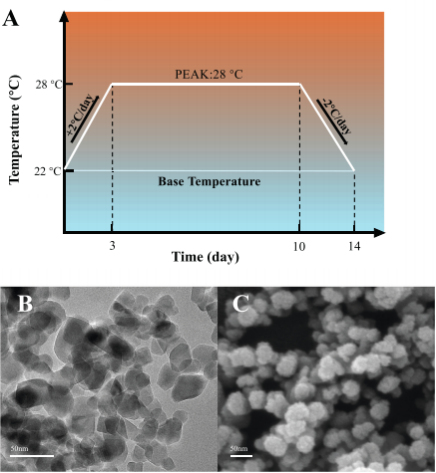
Nano-TiO2 (CAS No. 13463-67-7; P25, T823119; purity >99.8 %) was obtained from Shanghai Maclin Biochemical Technology Co., Ltd. (Shanghai, China). To minimize particle agglomeration, the nano-TiO2 suspension was sonicated at 50 W/L and 40 kHz using an ultrasonic homogenizer (UP200S, Hielscher Ultrasonic Technology, Teltow, Ger- many) prior to use. Before use, the surface morphology and structural characteristics of the nanoparticles were examined using scanning electron microscopy (SEM; GeminiSEM 360, ZEISS, Germany) and transmission electron microscopy (TEM; JEM-F200, JEOL, Japan). The particle size of the Nano-TiO2 was determined with a Zetasizer Nano ZS instrument (Malvern Panalytical, UK) via dynamic light scattering (DLS), while the ζ-potential was measured using the same equipment by means of laser Doppler velocimetry.
2.2. Experimental design
Based on multi-year thermal records in the East China Sea (ECS), which indicate a decadal average temperature of 22.3 ◦ C, 22 ◦ C was designated as the regional climatological baseline for seawater tem- perature normalization (Wang et al., 2020). Historical observational records indicate that the maximum summer sea surface temperature (SST) in the ECS has reached 28.3 ◦ C (Tan and Cai, 2018). Under climate change scenarios projecting an approximate 4 ◦ C increase in mean SST in the ECS by 2100 (F. Wang et al., 2023), a temperature of 28 ◦ C was designated as the critical threshold for simulating extreme MHWs con- ditions under controlled experimental conditions. The experimental thermal regime consisted of a 15-day cycle designed to simulate MHWs, dynamics. Starting from a baseline of 22 ◦ C, the temperature was increased by 2 ◦ C per day to reach a peak of 28 ◦ C by day 4. This peak temperature was maintained for 7 consecutive days to mimic sustained thermal stress, followed by a gradual cooling phase at a rate of 2 ◦ C per day until the baseline temperature was restored (Fig. 1A). Throughout the entire temperature control process, target temperatures were ach- ieved using electronic thermostats (Loligo Systems Apps, Tjele, Denmark), while a YSI ProQuatro multiparameter meter (Xylem Inc., USA) was employed for real-time temperature monitoring. The tem- perature regulation procedure consisted of three sequential phases: initially, over the first three days of the experiment, the water temper- ature was gradually increased from 22 ◦ C to 28 ◦ C at a rate of 2 ◦ C per day; subsequently, it was maintained consistently at 28 ◦ C for the
llowing seven-day mid-experiment period; finally, throughout the last three days, the temperature was reduced daily by 2 ◦ C, returning from 28 ◦ C to 22 ◦ C. Nano-TiO: exposure concentrations were systematically established at 25 μg/L (representing environmentally realistic levels) and 250 μg/L (simulating extreme pollutant scenarios) to evaluate dose- dependent ecological responses under both baseline and stressor- amplified conditions (Dedman et al., 2021; Labille et al., 2020).
A 3 × 2 factorial design was employed, incorporating three nano- TiO: concentrations (0 μg/L [control], 25 μg/L [environmental con- centration], and 250 μg/L [extreme environmental concentration]) and two temperature conditions (ambient vs. MHWs). Fifteen mussels were
housed in 5-L glass aquaria per treatment, with three biological repli- cates per experimental condition. Each experimental tank received nano-TiO2 suspensions once its seawater attained the target tempera- ture. The experimental nano-TiO2 concentrations were maintained by adding a new quantity of nano-TiO2 suspensions and bubbling with an air pump two hours after the second feeding of the day. The seawater was entirely replaced with fresh saltwater that matched the temperature of the exposure conditions. During the experimental period, there was no mortality.
2.3. Histological analysis
A total of three gonadal samples per tank were collected from female mussels in each group for the histological analysis. Tissues were briefly rinsed with physiological saline (0.9 % NaCl), fixed in Bouin’s solution, and then processed for paraffin embedding and hematoxylin-eosin (H&E) staining. Histological damage was assessed using a Leica DM3000 optical microscope (Leica Microsystems, Wetzlar, Germany) (Slaoui et al., 2017).
2.4. Hemolymph collection and handling
Hemolymph was aseptically drawn from the adductor muscle of mussels using a 2-mL sterile syringe. The collected fluid was immedi- ately filtered through a 400-mesh nylon cell strainer to eliminate par- ticulate matter and promptly cryopreserved on ice for subsequent analyses.
2.5. Preparation of tissue cell suspensions
A Hanks’balanced salt solution (Sigma-Aldrich, China) supple- mented with 1 % penicillin-streptomycin-gentamicin and a growth medium (Gibco, China) containing fetal bovine serum and antibiotics were prepared. Mussels were maintained overnight in sterile seawater, externally disinfected with ethanol, and dissected to collect mantle gland and gonadal tissues. The tissues were washed in Hanks’solution for 30 min, finely minced with sterile scissors until no visible fragments remained, and then enzymatically digested with trypsin. Digestion was terminated by adding PBS (Beyotime, China). The resulting suspension was filtered through a 400-mesh cell strainer, centrifuged, and the cell pellet was resuspended in culture medium to obtain a single-cell sus- pension for subsequent experiments.
2.6. Quantification offlow cytometric parameters
Flow cytometric analysis of mussel-derived samples was conducted using a BD AccuriⅢ C6 flow cytometer (BD Biosciences, USA). A total of 10,000 events were recorded per cell sample. To reduce interference from noise such as cellular debris and bacteria, a gate was applied in the FSC-A vs. SSC-A scatter plot to identify and enclose all cellular events, enabling clear visualization and selection of the population.
2.6.1. The cell viability (CV)
Hemolymph samples (3 mussels per tank) were used to determine CV by first preparing a SYBR Green staining solution composed of 100 μL SYBR Green and 900 μL dimethyl sulfoxide (DMSO), followed by a 100- fold dilution. Subsequently, 400 μL of hemolymph was incubated with 44 μL ofthe diluted staining solution at room temperature in the dark for 30 min before analysis (Hastings, 2023). In the FL1-H (SYBR Green fluorescence) vs. SSC-A scatter plot, a distinct population exhibiting high fluorescence intensity was gated to exclude non-nuclear debris and particles. This approach allowed accurate determination of cell viability within each treatment group.
2.6.2. Mitochondrial activity (Mito-Tracker Deep Red FM) and biomarker
of DNA double-strand breaks (γ-H2AX immunofluorescence)
Following optimization of reagent concentrations, mantle and gonadal cells (3 mussels per tank) were harvested from the prepared suspension and resuspended in the staining working solution. After appropriate incubation under dark conditions, samples were subjected to analytical detection, with all procedures strictly adhering to the manufacturer’s protocol (Beyotime, China) (Ren et al., 2023).
2.7. Gene expression analysis
The mantle gland and gonadal cells (3 mussels per tank) were
carefully collected, rapidly frozen in liquid nitrogen, and stored at − 80 ◦ C for subsequent RNA extraction. The total RNA was extracted using a commercial kit (Vazyme, China), and its concentration and pu- rity were assessed. Samples meeting quality criteria were used for cDNA synthesis with a reverse transcription kit (Vazyme, China). Quantitative real-time PCR (qRT-PCR) was performed on an ABI QuantStudio 6 Flex System (Applied Biosystems, USA) using ChamQ Blue Universal SYBR qPCR Master Mix, following a protocol modified from the manufac- turer’s instructions (Vazyme, China). Relative mRNA expression levels of the target genes were calculated using the 2^ − ΔΔCt method, with 18S rRNA serving as the endogenous reference gene (Livak and Schmittgen, 2001). The gene-specific primers (Table S1) were designed using Primer Premier 6.0 and commercially synthesized by Sangon Biotech (Shanghai, China).
2.8. Shell compression testing
After complete removal of soft tissues, each shell valve (3 mussels per tank) was horizontally positioned between parallel plates of a material testing machine (CTM6001, Xie Qiang Instrument Manufacturing, Shanghai, China), assuming negligible frictional force. The planar pro- jection of each shell was photographed prior to testing for subsequent calculation of the projected area. For compression testing, each intact shell was placed flat on the lower platform of the testing machine with the dorsal surface facing upward. The upper platen, connected to a load cell under computer control, was descended at a constant rate of 10 mm/ min. Force data were acquired in real time during the compression process. The test was automatically stopped when shell fracture occurred. The maximum force value at the point of fracture was recor- ded. The normalized compression load (CL) of the shell was calculated as CL = F / S, where F represents the fracture force and S denotes the projected area of the shell.
2.9. Statistical analysis
Data normality and homogeneity of variances were assessed using the Shapiro–Wilk and Levene’s tests, respectively, in SPSS software version 25.0 (SPSS Inc., Chicago, IL, USA). Two-way ANOVA and Tukey’s HSD test were employed to evaluate the effects of MHWs and nano-TiO: on mussel physiological indices, with statistical significance set atp < 0.05. To mitigate the effects of variations in dimensional units and measurement scales across different physiological indicators, all datasets were normalized to a range between 0 and 1 prior to conducting Principal Component Analysis (PCA) and correlation analysis. The min–max scaling method was applied to achieve this normalization. This procedure preserves the original distribution characteristics of the data while facilitating direct comparability among variables with divergent numerical ranges. All subsequent correlation analyses were performed using these normalized values. Principal component analysis (PCA) and correlation analysis were carried out using Origin 2024 (Northampton, MA, USA). Principal Component Analysis (PCA) was applied to identify the dominant patterns of variation across multiple physiological in- dicators. This technique reduces data dimensionality by transforming the original correlated variables into a set of linearly uncorrelated principal components. The first two principal components, which captured the major sources of variability, were retained for further interpretation and visualization. Correlation analyses were performed using Pearson’s correlation coefficient to evaluate linear relationships between the physiological variables. The correlation coefficient (r) ranges from − 1 to +1, with positive and negative values indicating direct and inverse linear associations, respectively. Statistical signifi- cance was defined as p < 0.05.The graphical visualizations were pro- duced in GraphPad Prism 8.0 (San Diego, CA, USA).